
Learn Korean With K-Dramas: A Practical Guide
How to learn Korean with K-dramas: where to find Korean subtitles, how to turn them on in Netflix, a step-by-step method, and dramas to start with.
To learn Korean with K-dramas, watch with Korean subtitles instead of English only, look up the words that keep coming back, and rewatch the same episode until you can follow it with less help. A drama gives you hours of everyday Korean in real situations. What turns that into learning is a routine: Korean on screen, a quick way to check words, and a few minutes of review afterwards.
Below: why dramas work, where to watch them with Korean subtitles, how to turn those subtitles on in Netflix, a step-by-step method, dramas sorted by level, and phrases you'll hear in almost every episode.
Learn Hangul first
Before you start, learn to read Hangul. It has 14 basic consonants and 10 basic vowels, and the letters were designed in the 15th century to be easy to learn. Most people can read it slowly after a few days of practice. Without it, Korean subtitles are just shapes, and your eyes will go straight to the English line every time. You don't need to read fast. You only need to recognize what you hear when you pause.
Why K-dramas work for learning Korean
You can learn Korean with dramas better than with many other kinds of video, for three reasons.
Lots of everyday speech. Most K-dramas are set in offices, schools, cafés and family homes. People order food, apologize, argue with their parents and complain about work. That is the Korean you'll actually need, and textbook dialogues rarely sound like it.
The same phrases, over and over. A 16-episode drama has the same characters saying the same things in slightly different situations. You'll hear "are you okay?" and "what do I do?" dozens of times per season, and each time it's a little easier to catch.
You can hear the speech levels. Korean has a polite style, 존댓말 (jondaetmal), for elders, bosses and strangers, and a casual style, 반말 (banmal), for close friends, family and children. In a drama you hear the switch happen: a new employee speaks politely to everyone, two characters fall out and go back to formal speech, a couple moves to banmal once they get close. Using banmal with the wrong person is rude in real life, so watching who uses which style with whom teaches you something a word list can't.
Where to watch K-dramas with Korean subtitles
Netflix
Netflix has a large K-drama catalog, and many Korean titles come with both English and Korean subtitle tracks. The catalog differs by country, so a drama that's on Netflix in one country may be missing in another. To see what has Netflix Korean subtitles where you are, go to netflix.com/browse/subtitles and filter by Korean.
Viki
Viki specializes in Asian dramas, and many of its titles come with subtitles in several languages written by its volunteer community. Viki used to offer a Learn Mode with Korean and English on screen together; its help page is no longer online, so check in the player whether the drama you want still has it. InterSub doesn't work on Viki, so if you watch there, use Viki's own settings.
YouTube
YouTube is good for short practice between episodes: drama clips, interviews with actors, vlogs and variety shows. Many Korean channels upload Korean captions; check the subtitle menu before you start. If a video only has auto-generated captions, expect some mistakes in names and fast speech.
How to get Korean subtitles on Netflix
The steps are the same on every device; only the way you open the menu changes.
- Start a Korean drama.
- Open Audio & Subtitles in the player. On a computer, move the mouse; on a phone, tap the screen; on a TV, press up or down on the remote.
- Choose Korean under Subtitles.
To make Korean appear by default, add it to your profile's languages in your Netflix account settings. A separate profile for practice keeps the rest of the household on English.
If Korean isn't in the list, Netflix's help center gives a few reasons. Subtitle languages depend on licensing for each title and country. Seasons offered before 2018 may lack some languages. Downloaded episodes keep only the two most relevant languages, so choose Korean before you download. And some older devices can't display Korean script at all; Netflix suggests 2014 as a rough guide. If Korean shows up on your laptop but not on an old TV, that's the reason.
Netflix plays one subtitle track at a time, though. For Korean and English together, you need a browser extension.
A Korean subtitles extension for Netflix and YouTube
A Korean subtitles extension adds a second line on top of the player, so you see the Korean line and its translation at the same time. InterSub does this in Chrome, Edge and Firefox on Netflix, YouTube, Prime Video, Disney+ and several other sites. The setup is the same one we describe for two subtitles on Netflix:
- Install InterSub.
- Open Netflix or YouTube in the browser and start a Korean video.
- In InterSub, set Korean as the language you're learning and English as the second line.
- Make the Korean line large enough to read comfortably.
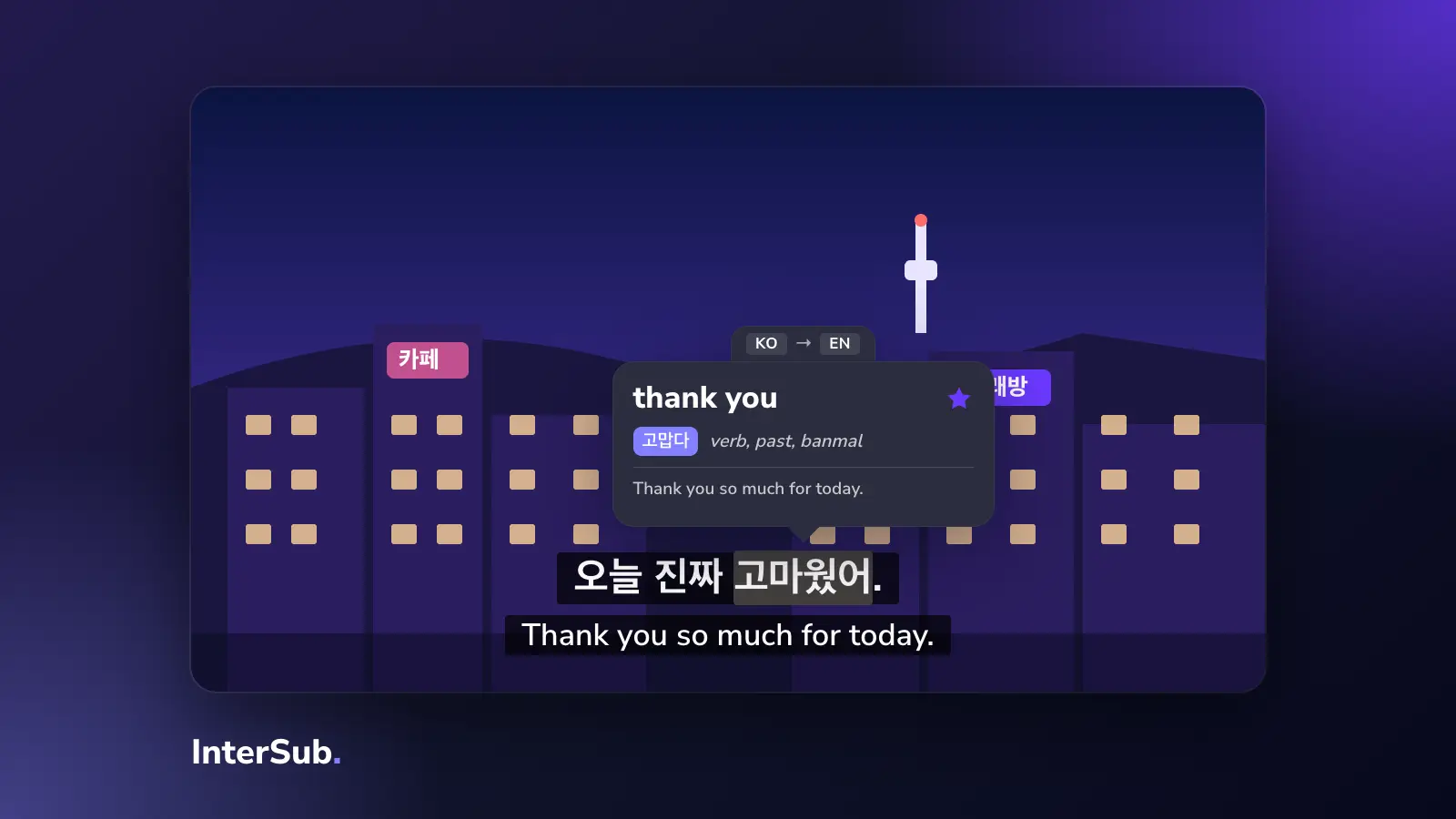
Now you watch with dual subtitles: Korean on top, English below. Hover over a Korean word and the video pauses and shows its translation with the words around it, so you can see which meaning fits the scene. Every word you look up goes to your Wordbook.
If a drama has Korean subtitles but none in your own language where you live, InterSub can translate the second line with AI. That is a paid feature, available during the free trial. It can't create the Korean line: if a title has no Korean track in your country, there's nothing to show. To compare InterSub with other tools, see dual subtitle extensions compared, or read what our dual subtitles extension does on each platform.
How to learn Korean with a K-drama, step by step
One episode, several passes. This is how to learn Korean with a K-drama rather than just watch it.
1. Watch with Korean and English
Follow the story first. Read the Korean line when it's short, lean on English when it's long. Don't stop on every word: you'll understand more on the second pass.
2. Hover over the words that repeat
When a word comes up for the third time, hover over it. Those are the words worth learning. The video pauses, you see the translation in context, and the word lands in your Wordbook.
3. Rewatch with English only on pause
Watch the same episode again with only the Korean line on screen. InterSub has a setting that shows the second line only when you pause, so English is there when you're stuck and out of the way the rest of the time. This is where most of the listening practice happens. If you want to know why this kind of watching works, read about comprehensible input.
4. Shadow short lines
Pick five short lines you liked and say them out loud along with the actor, copying the rhythm and intonation. Korean has a melody that's hard to get from a textbook, and dramas are full of short, emotional lines that are easy to copy. InterSub's shadowing mode pauses after each subtitle so you have time to repeat. Our guide to the shadowing technique explains the method.
5. Review your words
Spend ten minutes on your Wordbook the next day. You can export it or sync it with Anki, or practice saved words in the free InterSub Words Telegram bot. See all the ways to practice your words.
Stay with one drama for a whole season. By episode eight you'll catch lines you needed English for in episode one.
K-dramas on Netflix for learners, by level
All of these have Korean subtitles on Netflix, but catalogs vary by country, so check the title page where you are.
Easier: modern settings, everyday Korean
- Business Proposal. An office rom-com, 12 episodes. Good for hearing polite speech to a boss and casual speech between friends in the same scene.
- Hometown Cha-Cha-Cha. A dentist from Seoul moves to a seaside village. Neighbors, markets and small-town chat, at an easy pace.
Middle: more vocabulary, longer scenes
- Extraordinary Attorney Woo. A legal drama with courtroom vocabulary, but each case is mostly self-contained, so you can rewatch one without losing the thread.
- Crash Landing on You. A South Korean heiress lands in North Korea, so some characters speak North Korean, which differs from standard Seoul Korean in accent and some words.
Harder: dialect, speed, slang
- When Life Gives You Tangerines. A family story set on Jeju Island from the 1960s on. Older characters often use Jeju dialect.
- Squid Game. A thriller rated 18+. Fast arguments, slang and rough speech. Watch it once you're comfortable with easier shows.
Historical dramas (sageuk) are the hardest of all: old-fashioned speech and court titles you won't use anywhere else. Save them for later.
Phrases you'll hear in every K-drama
These come up in almost every episode. Notice how the meaning changes with the tone.
- 괜찮아 (gwaenchana). "It's okay" or "Are you okay?" With a question in the voice, it's asking; after an apology, it means "never mind." The polite form is 괜찮아요.
- 진짜? (jinjja?) "Really?" Said flatly, it can mean "you're kidding me." On its own it also works as "seriously."
- 어떡해 (eotteokae). A contraction of 어떻게 해, "what do I do?" In dramas it's usually a cry of "oh no" when something goes wrong.
- 대박 (daebak). Literally "jackpot." Used like "awesome" or "no way," usually for good news.
- 고마워 (gomawo). Casual "thanks." You'll hear the polite 고마워요 or the more formal 감사합니다 when characters talk to someone older or senior.
Listen for the -요 at the end: with it, the speaker is being polite; without it, they are speaking banmal.
If you're not sure two lines on screen suit you, read when double subtitles help and when they get in the way.
Frequently asked questions
Can you learn Korean from K-dramas?
Yes, as long as you study with them rather than just watch. Use Korean subtitles, look up words that keep coming back, rewatch scenes and repeat lines out loud. Dramas teach listening and everyday phrases well, but grammar is easier with a course alongside.
How do I get Korean subtitles on Netflix?
Start a Korean title, open Audio & Subtitles in the player and choose Korean under Subtitles. If Korean isn't listed, the title has no Korean track in your country, or your device is too old to show Korean script.
Is there an extension for Korean subtitles?
Yes. InterSub is a browser extension for Chrome, Edge and Firefox that shows Korean and English subtitles together on Netflix, YouTube and other sites, and translates any word when you hover over it.
What are the best K-dramas for learning Korean?
Start with modern romantic comedies set in offices or small towns, such as Business Proposal or Hometown Cha-Cha-Cha. Leave historical dramas, thrillers and shows with heavy regional dialects for later.
Should I learn Hangul before watching K-dramas?
Yes. Hangul has 14 basic consonants and 10 basic vowels, and most learners can read it slowly within a few days of practice. Without it, Korean subtitles are just shapes and you end up reading only the English line.