
Best Anime to Learn Japanese: 12 Picks by Level
The best anime to learn Japanese, from beginner to advanced: why each show suits learners, where to watch it legally, and one study tip for each.
The best anime to learn Japanese depends on your level. Beginners should start with slow, everyday shows such as Chi's Sweet Home, Polar Bear Cafe or Aggretsuko, where people talk about food, work and friends. Intermediate learners can move to school and family stories like Komi Can't Communicate or Spy x Family. Fast comedy and historical shows such as Gintama or Rurouni Kenshin are for advanced learners.
Below are twelve picks grouped by level. For each one: why it suits learners, where to watch it legally, and one way to study with it. After the list: what kind of Japanese anime actually uses, and how to learn Japanese through anime without just reading English subtitles.
How we picked these anime for Japanese learners
Good anime for Japanese learners isn't always the best anime overall. We looked at four things:
- Speech speed. Calm dialogue is easier to follow than rapid comedy.
- Vocabulary. Cafes, offices and schools teach words you'll use. Magic and sword fights mostly don't.
- Register. Some shows use mostly casual speech between friends; others mix in polite keigo, rough slang or old-fashioned speech.
- Japanese subtitles. You learn more when you can read what you hear, and not every platform has a Japanese track for every show.
Availability varies by country and changes over time. We checked US listings in October 2026; check your own region before subscribing.
Beginner anime: short, slow and everyday
Chi's Sweet Home
A lost kitten is taken in by a young family. Episodes are a few minutes long, and the kitten talks like a toddler, so the grammar stays simple. The family speaks everyday home Japanese: meals, bath time, going out.
Where to watch: Crunchyroll and Netflix in the US; Crunchyroll in several other regions.
Tip: Watch one episode three times in a row. With episodes this short, that takes about ten minutes.
Polar Bear Cafe (Shirokuma Cafe)
A polar bear runs a cafe where a lazy panda and a penguin are regulars. Nobody hurries, and most talk is about drinks, part-time jobs and small worries. The polar bear tells puns constantly, a fun way to notice how similar words sound.
Where to watch: Crunchyroll.
Tip: When a pun goes over your head, look up both words. Puns are a quick lesson in pitch and vowel length.
Aggretsuko
A red panda works in an office accounting department. You hear polite workplace Japanese with bosses and colleagues, then casual speech with friends after work. That makes it one of the clearest shows for hearing keigo and casual speech side by side.
Where to watch: Netflix (a Netflix original, so it usually has a Japanese subtitle track).
Tip: Every time someone switches from polite to casual speech, pause and ask who they're talking to.
Laid-Back Camp
High school girls go camping in winter. The pace is slow, and the vocabulary is practical: food, weather, trains, gear. One girl speaks a Kansai-style dialect you'll hear in many other shows.
Where to watch: Crunchyroll.
Tip: Keep a short list of the food and weather words. They come back in almost every episode.
Stand by Me Doraemon
The Doraemon TV series is a children's classic in Japan, but in the US it isn't streaming right now. The CGI film Stand by Me Doraemon is on Netflix there: kids' speech, clear delivery and a story most Japanese people know.
Where to watch: Netflix in the US; the TV series is available in some other countries.
Tip: Netflix's Japanese subtitle guidelines call for furigana more often in children's content. When you see it, read the kana aloud before checking the kanji.
Intermediate anime: school, family and everyday drama
Komi Can't Communicate
A shy girl can barely speak, so her classmates do the talking. Lots of school vocabulary, and a big cast whose speaking styles range from childish to formal.
Where to watch: Netflix.
Tip: Pick one side character and follow only their lines for an episode. You'll start to hear how speech marks a personality.
Spy x Family
A spy, an assassin and a telepathic child form a fake family. The father speaks carefully, the mother is very formal, and the daughter uses broken child speech. Action scenes are fast; family scenes are easy to follow.
Where to watch: Crunchyroll and Netflix in the US; Bilibili.tv lists it in Southeast Asia.
Tip: Don't copy the daughter's grammar. Her mistakes are on purpose. Compare her lines with the correct form in the subtitles.
Kaguya-sama: Love Is War
Two student council leaders, each too proud to confess. The narrator speaks fast and the characters use elevated, sometimes theatrical vocabulary. Harder than Komi, but it rewards rewatching.
Where to watch: Crunchyroll.
Tip: Turn on "show subtitles only on pause" for the narrator's monologues and try to catch them by ear first.
Frieren: Beyond Journey's End
An elf mage looks back on a quest after her friends grow old. It's fantasy, so some words are about magic and monsters. But the pace is calm and most conversations are about regret and time passing.
Where to watch: Crunchyroll and Netflix in the US; Bilibili.tv lists it in Southeast Asia.
Tip: Skip the spell names. Save the words for emotions and time, which you'll use far more.
Advanced anime: fast, specialized or old-fashioned speech
Steins;Gate
A self-proclaimed mad scientist accidentally builds a time machine. Expect scientific terms, internet slang and a hero who talks in dramatic, made-up phrases. Save it for when normal conversation feels easy.
Where to watch: Crunchyroll.
Tip: Look up words in context. A dictionary entry alone often won't explain slang.
Gintama
A samurai comedy set in an alternative Edo with aliens. Very fast jokes, parodies of other anime, wordplay and rough speech everywhere. Even native speakers miss references.
Where to watch: Crunchyroll and Netflix in the US.
Tip: Accept that you won't catch every joke. Rewatch a scene once, then move on.
Rurouni Kenshin (2023)
A wandering swordsman in early Meiji Japan. Kenshin's polite, old-fashioned speech, with an archaic word for "I" and archaic sentence endings, is famous among learners: you should recognize it and never use it.
Where to watch: Crunchyroll and Netflix in the US.
Tip: Write down each archaic form next to its modern equivalent. That turns a hard show into a grammar lesson.
What type of Japanese is used in anime
If you're wondering what type of Japanese is used in anime, the short answer is: mostly casual spoken Japanese, but stylized. Characters are friends, classmates and family, so you hear plain verb forms, dropped particles and short sentences. That's useful: textbooks spend a long time on polite -masu forms, and anime fills the other half.
What makes anime Japanese different is character speech. Japanese linguist Satoshi Kinsui called it yakuwarigo, "role language": ways of talking that instantly tell you a character's age, gender or type. The old professor, the tough guy, the princess and the samurai each have their own pronouns and sentence endings.
First-person pronouns are the easiest place to hear it. An invented example of one sentence, "I'll go," said by three different characters:
俺が行く。
I'll go. (rough, casual; a tough male character)
僕が行きます。
I'll go. (polite; a gentle boy or young man)
わたくしが参ります。
I shall go. (very formal; a butler or a refined lady)
All three are correct Japanese, and each tells you who is speaking. In conversation, copying a rough hero's ore and blunt endings can sound aggressive. Archaic speech or a cute ending like a catchphrase sounds like a costume. Use anime to train your ear, and learn polite speech for real life from a course or real conversations. Forms of address work the same way: our guide to Japanese honorifics explains what -san, -kun and -chan say about a relationship.
How to learn Japanese through anime
Watching with English subtitles mostly trains your English reading. To learn, you need the Japanese on screen too, so anime with Japanese subtitles is where any routine starts.
Use Japanese and English subtitles together
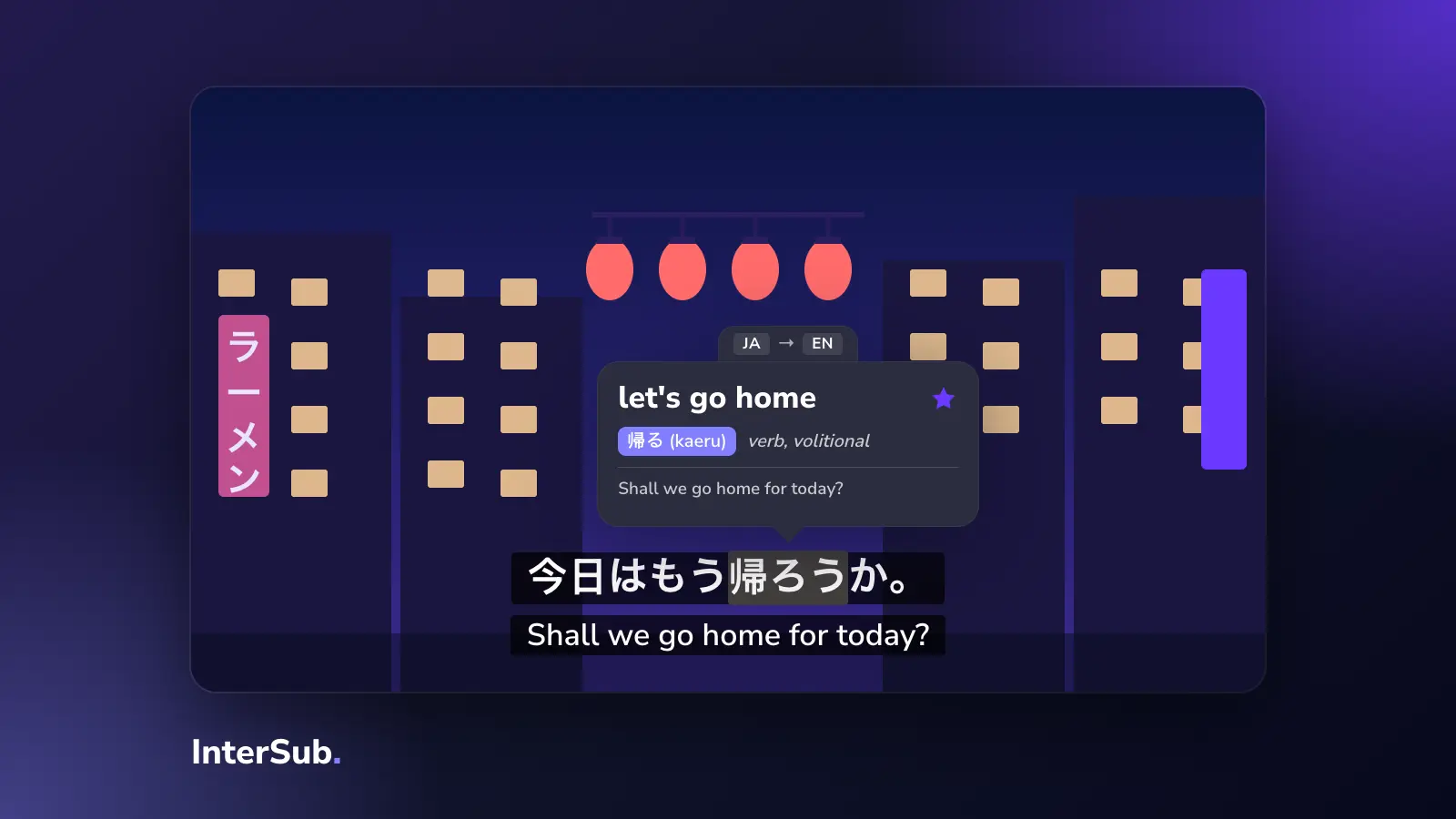
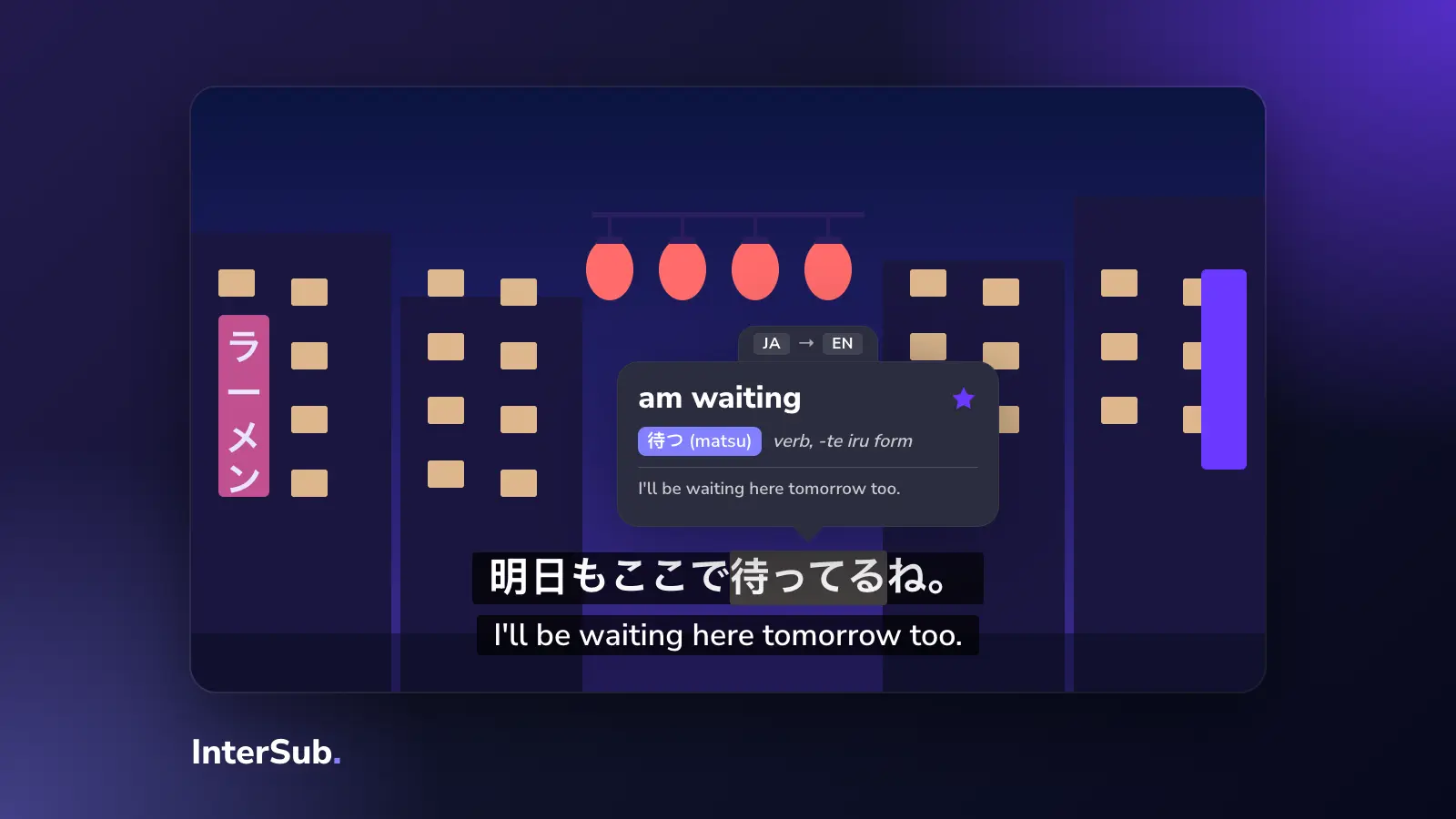
Streaming players show one subtitle track at a time. A browser extension like InterSub adds a second line, so you can watch with dual subtitles: Japanese on top and English or your own language below. You read the Japanese, and glance at the translation only when you're lost. It works on Crunchyroll, Netflix and Bilibili.tv in Chrome, Edge and Firefox.
Look up words without leaving the episode
Hover over a word in the Japanese line and the video pauses and shows its translation with the words around it, so you can tell which meaning fits the scene. In anime the same word can be a joke or a threat depending on who says it.
Keep your words in a Wordbook
Each word you look up is saved to your Wordbook, with the line it came from. Review it the next day, export it, or sync it with Anki. The free InterSub Words Telegram bot can also quiz you on saved words; see all the ways to practice them on the install page.
Rewatch and shadow
Rewatching one episode teaches more than watching three new ones. On the second pass, show the translation only when you pause. Then repeat a few lines out loud along with the actor. Our guide to the shadowing technique explains how, and InterSub's shadowing mode pauses after each subtitle line to give you time.
Where to watch anime with Japanese subtitles
Netflix usually has a Japanese track on anime it releases as its own; our post on Netflix Japanese subtitles explains how to turn it on and why it's sometimes missing.
Crunchyroll has the biggest anime catalog, but Japanese subtitles depend on the show and your region. If InterSub keeps showing "Loading subtitles" on Crunchyroll, the video most likely has no Japanese subtitles where you are. Crunchyroll decides which subtitles each region gets, and InterSub can only use the ones it provides. Our page on how to learn Japanese with anime covers the Crunchyroll setup in detail.
Bilibili.tv carries many anime titles in Southeast Asia; check the title page for available subtitle languages.
If a show has Japanese subtitles but no line in your language, InterSub can translate the second line with AI. This is a paid feature, also included in the free trial.
Learning Japanese to watch anime: a realistic plan
If you're learning Japanese to watch anime, start with kana and a basic course, then add one beginner show from this list. Watch an episode with both lines, look up five words, and rewatch it the next day with Japanese only. Move up a level when you rarely need the English line. For live-action practice after anime, see our list of Japanese movies with subtitles.
Frequently asked questions
What is the best anime to learn Japanese for beginners?
Short slice-of-life shows with slow, everyday speech: Chi's Sweet Home, Polar Bear Cafe, Aggretsuko or Laid-Back Camp. Avoid fast action and fantasy at first, because the vocabulary is less useful and harder to follow.
Can you learn Japanese from anime?
You can learn a lot of listening, vocabulary and natural phrasing from anime, especially with Japanese subtitles and a dictionary at hand. On its own it won't teach you grammar systematically or polite speech for real life, so combine it with a course or textbook.
Is anime Japanese different from real Japanese?
Partly. Everyday shows use ordinary casual Japanese, but many characters speak in exaggerated styles: rough male speech, old-fashioned samurai speech, cute endings. These tell you who the character is and sound odd if you copy them in real conversation.
Where can I watch anime with Japanese subtitles?
Netflix usually has Japanese subtitles on the anime it releases as its own. Crunchyroll has the biggest anime catalog, but whether a video has Japanese subtitles depends on the show and your region.
How long does it take to understand anime without subtitles?
It depends on the show and on how much you study. Simple slice-of-life becomes followable much sooner than fast comedy or historical drama. Learners who watch with Japanese subtitles and look words up daily usually notice progress within a few months.