
Comprehensible Input: How to Learn From Shows
Comprehensible input explained: Krashen's input hypothesis, how much you need to understand, and a four-stage subtitle setup for learning from shows.
Comprehensible input is language you hear or read and mostly understand, with a little that is new. The idea comes from linguist Stephen Krashen: you acquire a language by understanding messages in it, not by memorizing rules. For a self-learner who watches shows, the practical question is how to keep what you watch understandable, and subtitles are the main tool for that.
What is comprehensible input?
If you search what is comprehensible input, you'll find the short version above. The longer version starts with Krashen's book Principles and Practice in Second Language Acquisition (1982), where he set out five hypotheses about how people pick up a second language. Two of them matter most for anyone learning from video.
The input hypothesis and i+1
The input hypothesis says we move forward when we understand input that is slightly beyond our current level. Krashen wrote this as i+1: i is what you can already handle, +1 is the next small step. You don't need to know every word, because context, the picture and what you know about the world fill the gaps.
A cooking show is a good example. You may not know the word for "whisk", but you watch someone whisk eggs while saying it. That is i+1 in action.
The affective filter hypothesis
The affective filter hypothesis says that anxiety, low motivation and low confidence act like a filter. Input can be perfectly understandable and still not stick if you are stressed or bored. For a learner this has a simple meaning: material you enjoy, watched without pressure, works better than material you force yourself through.
The critics
Krashen's ideas are popular with learners and debated by researchers. Merrill Swain's output hypothesis (1985) argued that understanding is not enough, and that you also need to produce language, because speaking and writing make you notice what you can't yet say. Michael Long's interaction hypothesis argued that conversation, where people adjust what they say until both sides understand, is a big part of how input becomes useful.
Input is necessary and does a lot of the work, but most researchers don't think it is the whole story. Use input for listening and vocabulary, and add speaking when you can.
What "comprehensible" means in practice
For comprehensible input language learning to work, you have to understand most of what you hear. How much is "most"?
The best-known numbers come from reading research. In a 2000 study, Hu and Nation found that readers needed to know about 98% of the words in a text for adequate comprehension without help; at 95% comprehension was noticeably weaker. Later studies questioned how sharp that threshold is, and a 2023 replication didn't fully reproduce the original results. Treat 95–98% as a useful target, not a law.
For TV, Webb and Rodgers (2009) estimated that knowing the 3,000 most frequent word families covers about 95% of the words in typical programs, and about 7,000 families covers 98%. Video also gives you faces, places and actions, so you can follow a scene with fewer known words than a book needs.
A quick test: watch five minutes without stopping. If you can retell what happened and only a few words per minute are lost, the level is right. If you are guessing the plot from the picture, it is too hard for now.
How subtitles fit: a four-stage setup
Subtitles let you turn hard material into understandable material. The goal is to use less help over time without ever dropping into a show you can't follow. Here is a staged setup, with the matching InterSub settings.
Stage 1: dual subtitles
Show the language you are learning and your own language at the same time. You hear the line, see it written, and check the meaning in one glance. With dual subtitles a show that is too hard on its own becomes comprehensible input. Put the target language where your eyes go first; there is more on layout in our guide to double subtitles.
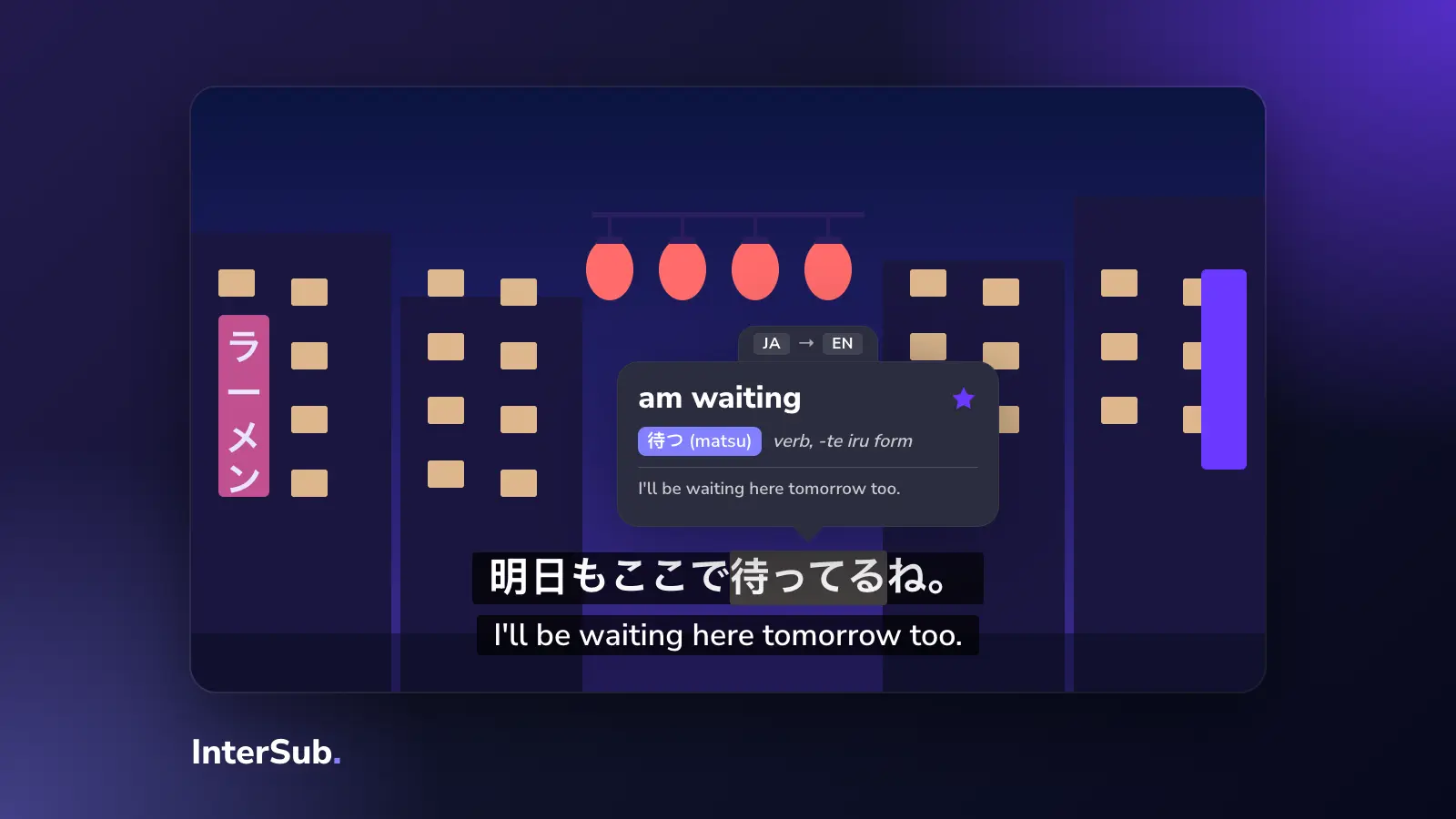
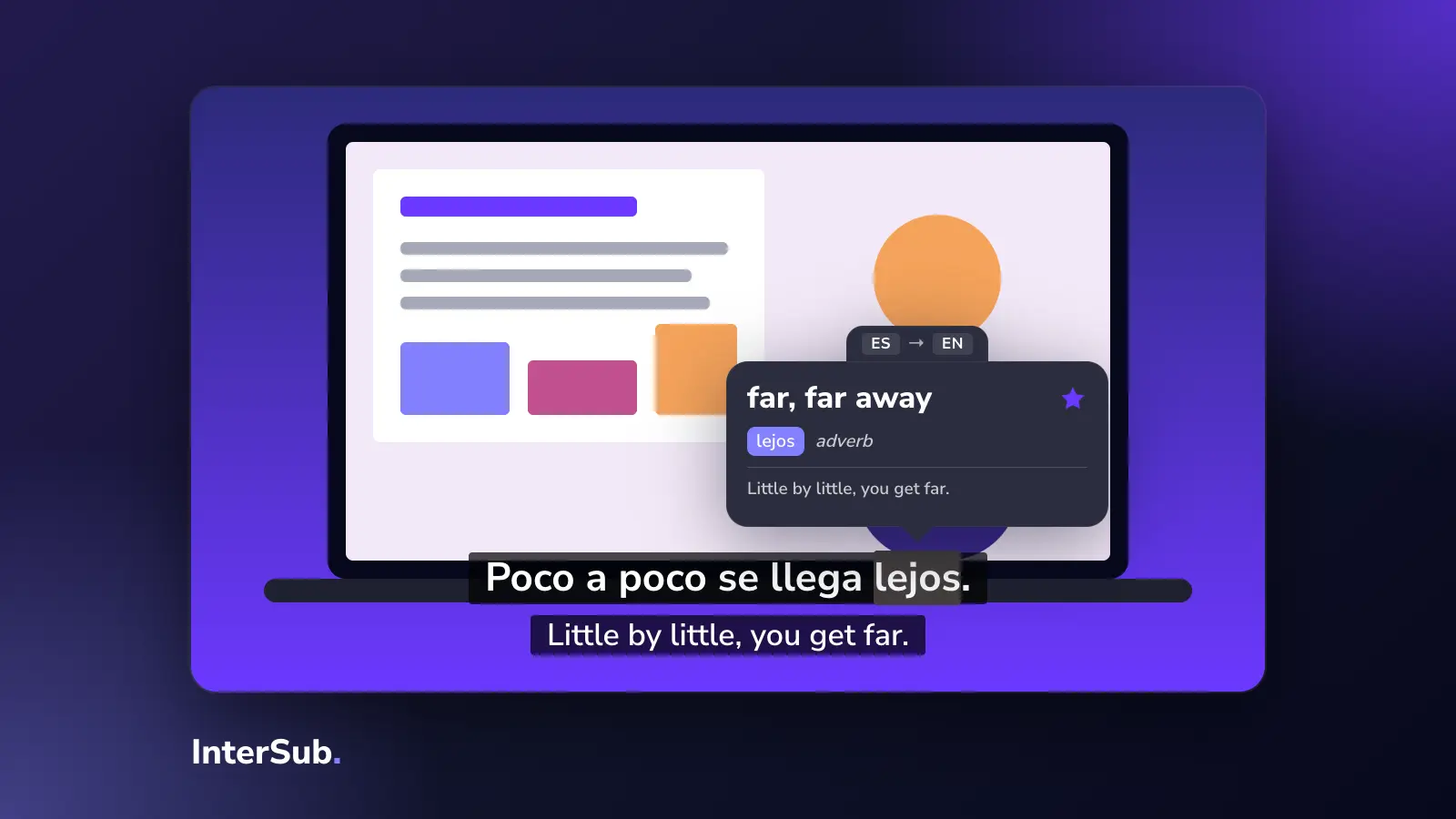
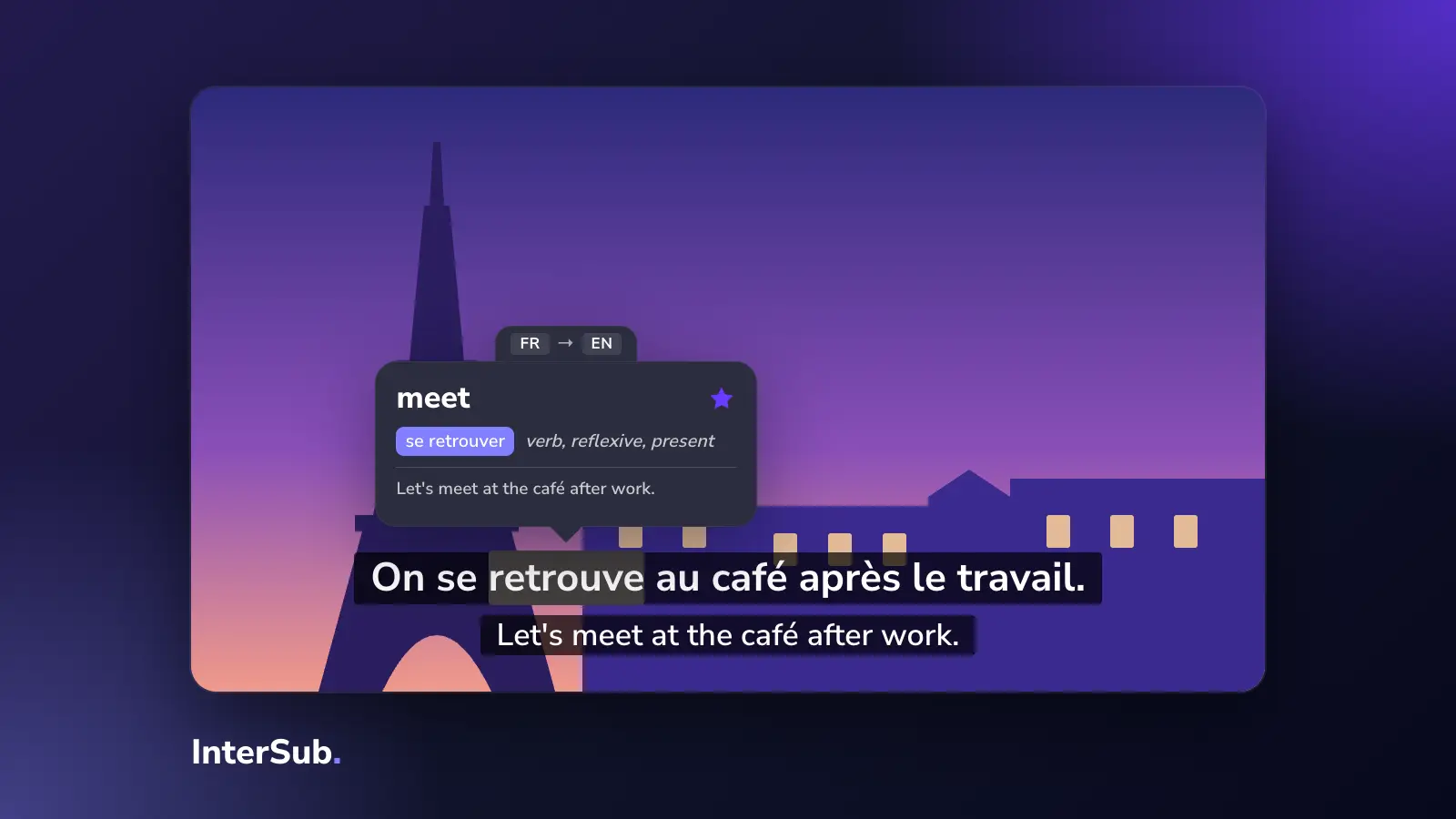
When you hit a word you don't know, hover over it. The video pauses and InterSub shows the translation with the surrounding words, so you see what the word means in this scene. The word goes to your Wordbook.
Move on when you notice you only glance at your own language to confirm what you already understood.
Stage 2: target-language subtitles, translation on pause
Keep the target-language line and show the second line only on pause. You read and listen in the language you are learning, and you check the translation only when you stop. Many people stay here for months.
Move on when you pause mainly for single words, not for whole lines.
Stage 3: subtitles only on pause
Turn on "Show subtitles only on pause". No text appears while the scene plays, so you listen first. When you pause, InterSub shows the current line and the one before it, which helps when you missed something a second ago. You can still hover a word to translate it.
Move on when you rarely pause in familiar shows and could follow a new episode of the same series.
Stage 4: no subtitles
Turn subtitles off for shows you know well, and keep stage 2 or 3 for new ones. Different shows can sit at different stages at the same time: a sitcom may be at stage 4 while a crime drama with fast slang is still at stage 2.
You can set all of this up with a dual subtitles extension on Netflix, YouTube, Prime Video, Disney+ and other platforms, in Chrome, Edge or Firefox.
Picking material at the right level
Level matters more than genre. What helps:
- Start with slow, clear speech. Learner YouTube channels, children's shows and podcasts made for learners are easier than films.
- Pick shows with one setting and a small cast. Sitcoms and family dramas repeat the same words episode after episode. Thrillers and period dramas don't.
- Watch a series, not random episodes. The same characters, places and phrases come back, and every episode is easier than the last.
- Rewatch. An episode you already understand at stage 2 can become a stage 3 episode on the second viewing.
- Drop what you can't follow. If a show stays at the "guessing from the picture" level after two episodes, park it for later.
A weekly plan
This plan assumes about an hour a day. Shorten it if you need to; regularity matters more than length.
| Day | What to do | Subtitle stage |
|---|---|---|
| Monday | New episode of your main series | Stage 1 or 2 |
| Tuesday | Same episode again, looking up words you skipped | One stage higher |
| Wednesday | Something lighter: learner YouTube, a podcast | Stage 2 or 3 |
| Thursday | Next episode of your main series | Stage 1 or 2 |
| Friday | Review your saved words, then rewatch favourite scenes | Stage 3 |
| Saturday | A longer session: a film or two episodes | Your current stage |
| Sunday | Speaking: repeat lines out loud or talk to someone | Any |
On Sunday, try the shadowing technique: InterSub's shadowing mode pauses after each line so you can repeat it. That covers part of what Swain's and Long's critiques say input alone misses.
Comprehensible input for Spanish
If you're looking for comprehensible input Spanish material, you have more choice than almost anyone, because there is so much Spanish-language TV. A path that works for many:
- First weeks: learner channels on YouTube with slow, clear Spanish, at stage 1.
- First series: a show with everyday dialogue and a small cast, at stage 1, then stage 2 once you follow the characters. Our list of Spanish shows on Netflix sorts series by difficulty.
- Later: fast comedies and shows full of regional slang, at stage 2.
Mind the accents. Spain, Mexico, Argentina and Colombia sound different, and a show from one region may feel harder than its vocabulary suggests. Stick to one accent at first, then branch out.
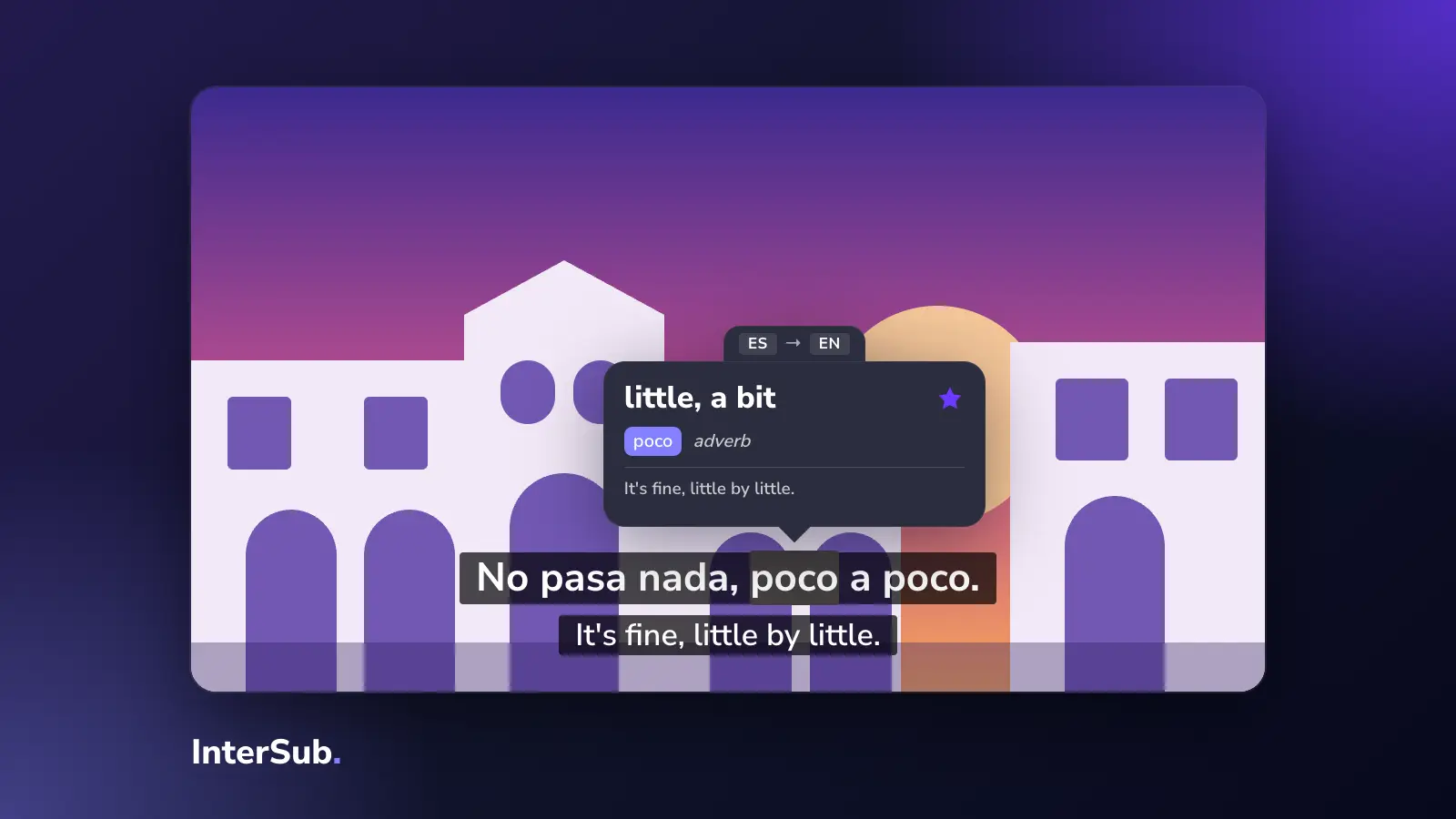
A line like this is typical early material:
No pasa nada, poco a poco.
It's fine, little by little.
At stage 1 you read both lines. At stage 2 you hear it, see the Spanish, and only check the English if poco a poco is new. By stage 3, you just hear it.
Where comprehensible input stops
Input gives you listening and a large passive vocabulary. It won't make you speak fluently by itself, and it is slow at the very start, when almost nothing is understandable. That is where an app or a course helps; see our Duolingo alternatives if you want something to pair with your shows.
Frequently asked questions
What is comprehensible input?
Comprehensible input is language you hear or read and mostly understand, with a small amount that is new to you. The term comes from Stephen Krashen, who argued that we acquire a language by understanding messages in it.
Does comprehensible input work?
Understanding a lot of language clearly helps, and almost no researcher disputes that input matters. The debate is whether input alone is enough; many researchers argue that speaking, writing and conversation add things that listening cannot.
How much input do you need?
There is no single number, because it depends on the language and on how much of each hour you actually understand. A steady habit of about an hour a day of material at your level does more than occasional long sessions you can't follow.
Can you learn a language just by watching shows?
You can build strong listening and a large passive vocabulary from shows, especially if you pick material you mostly understand and look up the words that keep coming back. Speaking well usually needs practice on top of that.
Comprehensible input vs Duolingo, which is better?
They do different jobs. An app like Duolingo gives you short exercises and a first vocabulary; comprehensible input gives you hours of real language. Many learners start with an app and move most of their time to input once they can follow simple content.