
ChatGPT for Language Learning: Prompts, Limits, AI Tutors
ChatGPT for language learning: what it does well, where it fails, 8 prompts to copy, and AI tutors that know the words you met in real shows.
ChatGPT for language learning works best as a patient explainer and practice partner: it can break down grammar, give you example sentences, play a role in a conversation and correct short texts. It does not replace real listening, it sometimes states made-up facts with full confidence, and it has no built-in plan for reviewing the words you learned. Use it for questions and practice, and pair it with real video and spaced repetition.
What ChatGPT does well
People who try ChatGPT language learning for a few weeks usually land on the same short list of uses. They are also the ones that come up again and again in threads about language learning through Chat GPT on Reddit.
- Explaining grammar in plain words. Ask why a sentence uses the subjunctive or why a Japanese verb changes form, and you get a clear answer with examples, at your level, as many times as you need.
- Generating examples. Ten sentences with one word, five ways to say "I'm tired", a short dialogue at a café. Examples are cheap for a chatbot, and they are exactly what textbooks run short of.
- Role-play conversation. It can be a waiter, a landlord or a job interviewer. With voice mode you can practice out loud without the stress of a real person waiting for your answer.
- Correcting your writing. Paste a few sentences and it points out mistakes. This is the most useful feature for many learners, as long as you control how much it changes.
OpenAI also added a study mode to ChatGPT in 2025 that asks guiding questions instead of handing over answers. It helps with homework-style tasks. For a language, the same strengths and limits apply.
Where general chatbots fail
AI for language learning has real weak spots, and it's better to know them before you trust an answer.
- Made-up facts. Ask where a word comes from or which film a quote is from, and a chatbot may produce a confident story that is simply wrong. Etymology is a classic trap. Check facts like these in a real dictionary.
- Inconsistent corrections. Paste the same paragraph twice and you can get two different sets of corrections. Sometimes it "fixes" a sentence that was fine, or rewrites your style into its own.
- No record of what you studied. ChatGPT can keep some memory across chats if you turn it on, but those are loose notes about you, not a list of your words with their meanings and the scenes you met them in.
- No spaced repetition. Nothing reminds you to review a word three days later, then a week later. Without that, most new words fade.
- Text without listening. Everything happens in a chat window. The language you need to understand lives in real speech: fast, unclear, full of slang. A chatbot can't give you the hours of natural audio that the comprehensible input approach is built on.
8 prompts to copy
Good prompts are short and set limits. Replace the parts in brackets.
1. Explain a word in its scene
I'm learning [Spanish], level [B1]. In a show, a character says: "[exact line]". What does "[word]" mean here, and is it common in everyday speech? Answer in [English], under 80 words.
2. Correct without rewriting
Correct these 3 sentences. Change only real mistakes, keep my words and style. After each sentence, explain each fix in one short line. [your sentences]
3. Quiz me
Quiz me on these words, one question at a time: [word list]. Mix question types: meaning, translation, fill in the blank. Wait for my answer before the next question, and keep score.
4. Role-play with limits
Let's role-play. You are a [pharmacist] in [Madrid], I'm a customer. Use only [A2] vocabulary, short replies, and don't correct me during the scene. At the end, list my 3 most important mistakes.
5. Same idea, different registers
Show me how to say "[I can't make it tonight]" in [French] in 4 ways: very casual, neutral, polite, formal. One line each, with a short note on when to use it.
6. Grammar with my own examples
Explain [the difference between ser and estar] in 5 bullet points. Then give me 4 sentences with a blank and let me choose. Don't show answers until I reply.
7. Make a line easier to understand
Here is a line from a video I didn't understand: "[line]". Split it into chunks, translate each chunk, then say it again at normal speed in simpler words.
8. Check a fact honestly
Where does the word "[word]" come from? If you're not sure, say so, and tell me which dictionary I should check.
Prompt 8 matters more than it looks. Asking a chatbot to admit uncertainty reduces the made-up stories, though it doesn't remove them.
AI language tutors connected to what you watch
A general chatbot only knows what you paste into it. An AI language tutor built into your learning tools can start from the word you looked up, the line you heard it in, and the list of words you already saved. That is the gap two InterSub tools fill. They are different tutors, but they work by similar instructions, and both run on OpenAI models.
AI Language Buddy in the InterSub extension
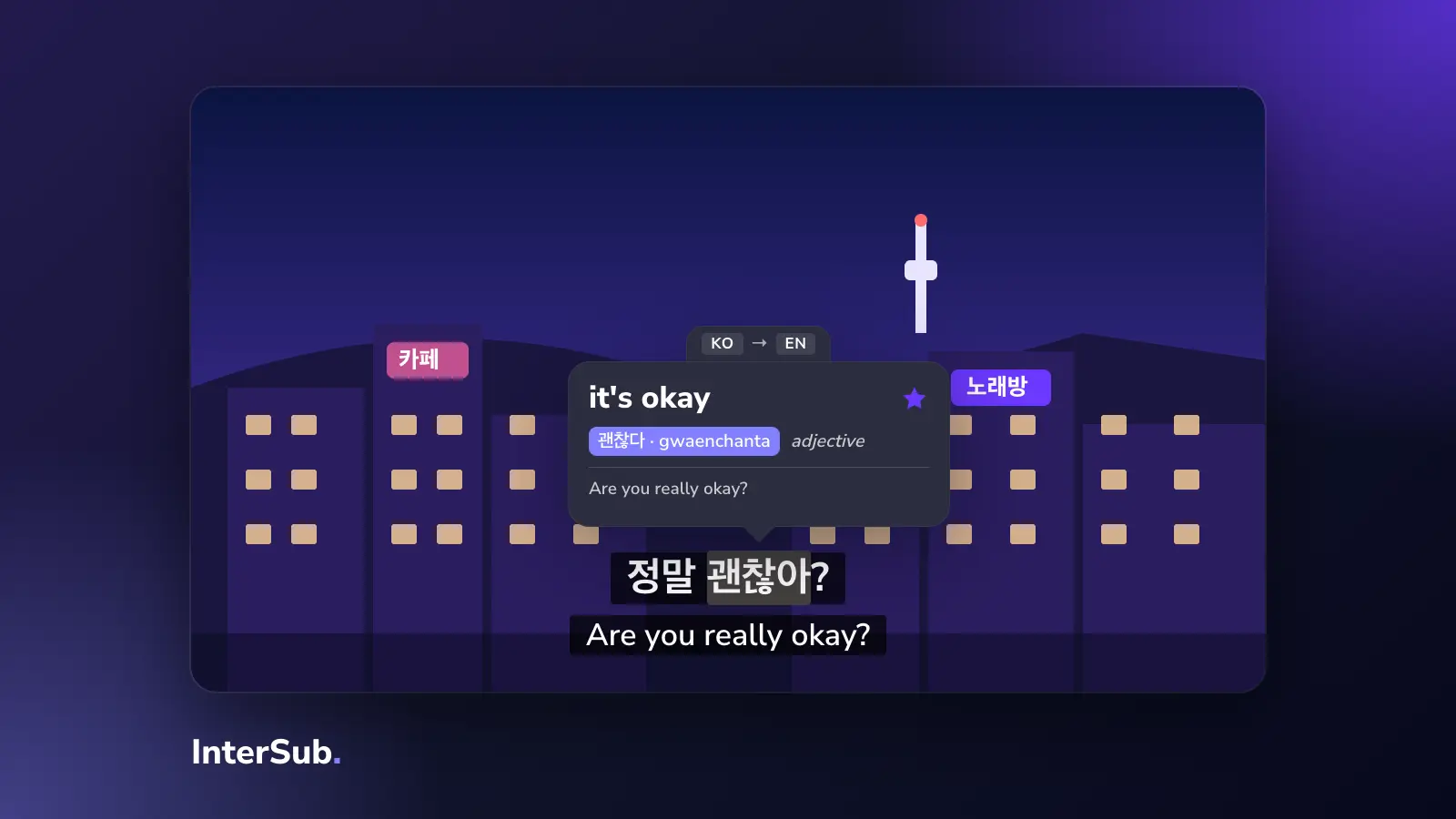
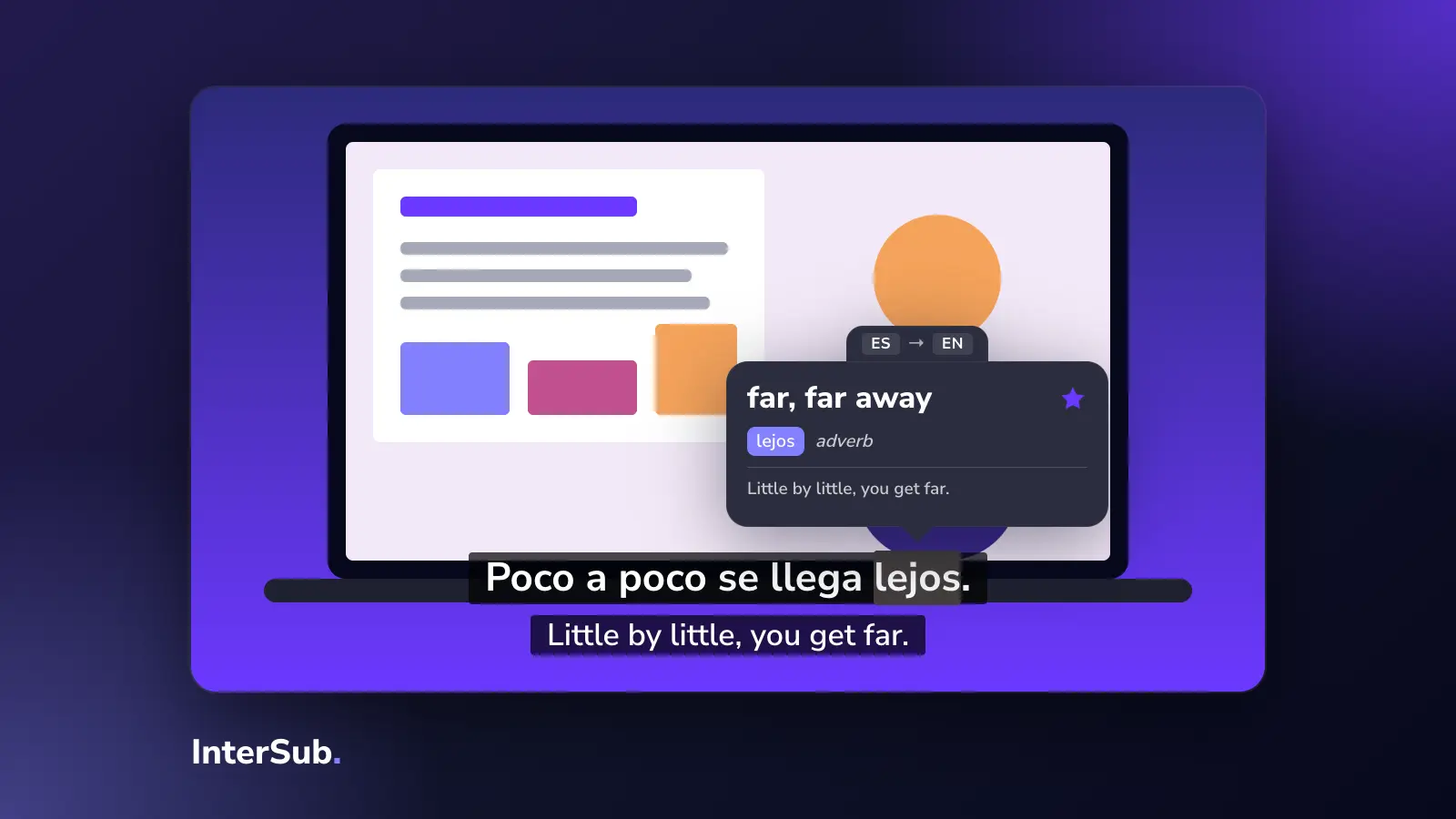
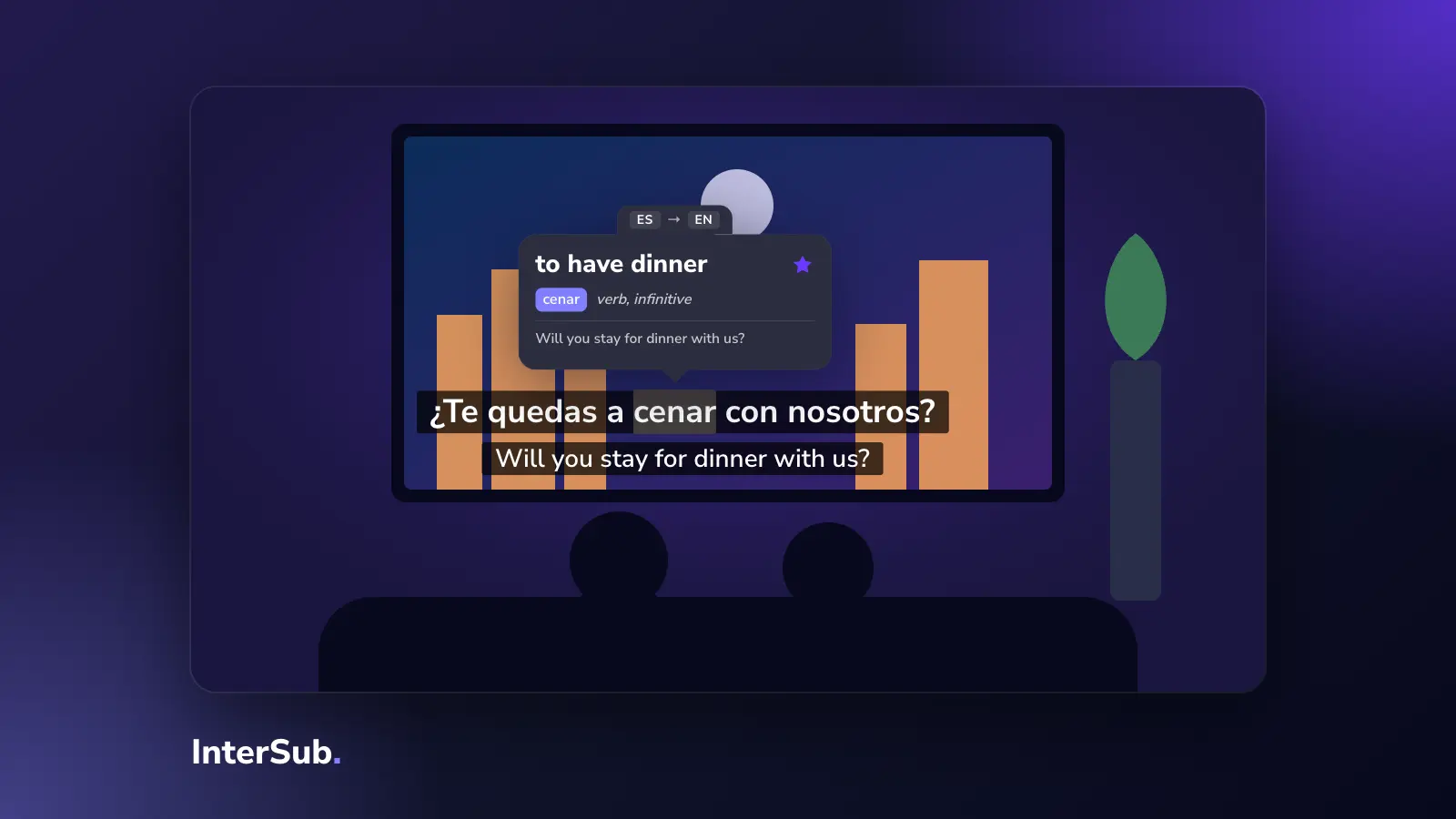
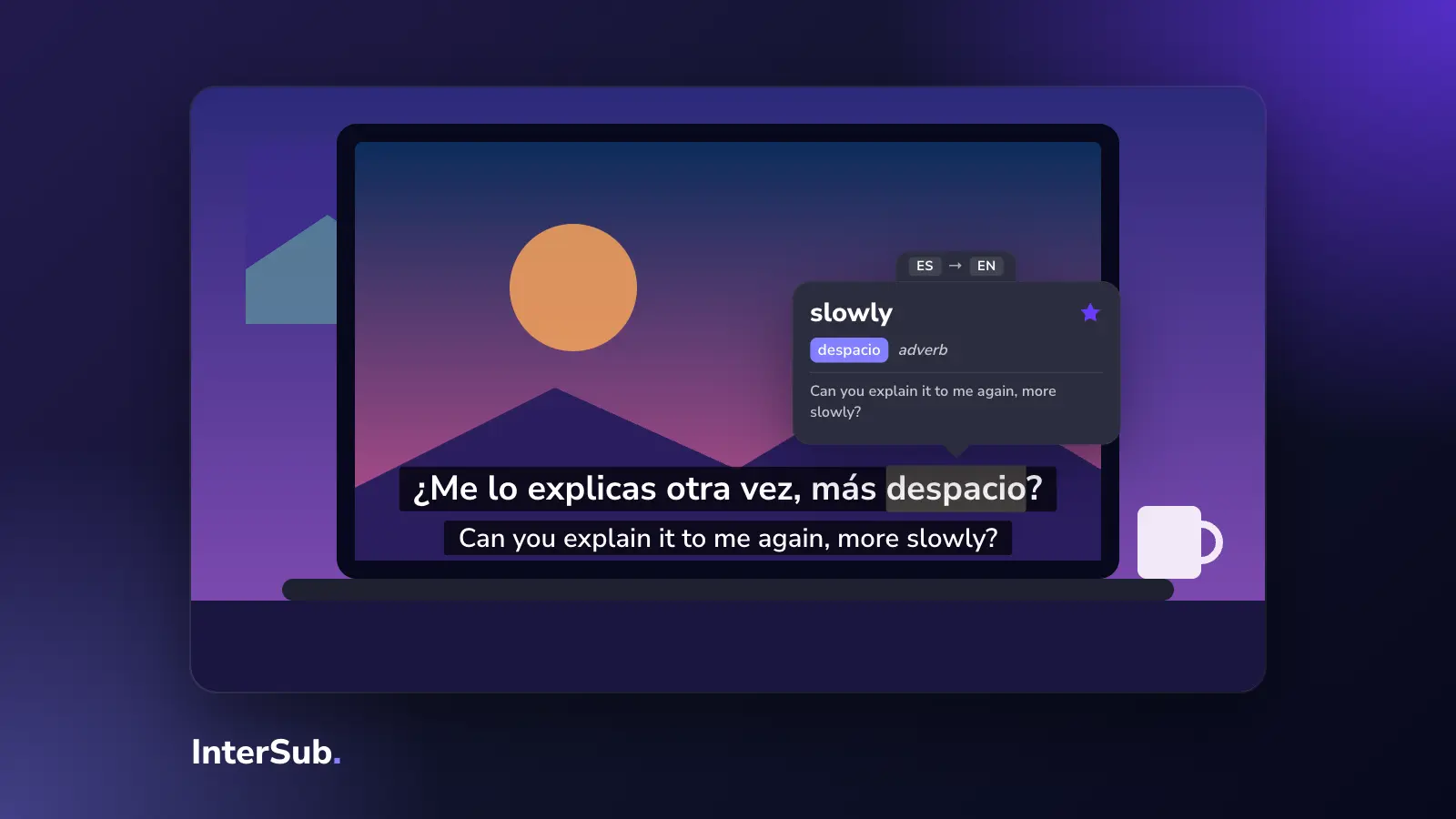
InterSub is a dual subtitles extension for Chrome, Edge and Firefox. It shows the original line and a translation at the same time on YouTube, Netflix, Prime Video, Disney+ and other sites, and you can hover any word to see its translation in context.
Next to that translation sits the Magic button. Click it and a chat with AI Language Buddy opens, already knowing the word and the scene. You can ask:
- what the word means in this exact scene;
- how to use it;
- which synonyms fit;
- how the grammar works;
- any question of your own.
If you like an explanation, you can save a dictionary-style definition from the chat straight to your Wordbook. Buddy works on every InterSub plan, including the free one: its questions use the same allowance as word lookups, so as long as you have lookups left, you can ask Buddy. See the plans for current limits.
The InterSub Words bot on Telegram
Looking up a word is step one. Remembering it is a separate job, and that is what the InterSub Words bot does. It is free and runs in Telegram.
You connect your InterSub Wordbook (or upload your own words, or pick a ready-made topic list), and the bot takes you through each word.
A word card. First it asks whether you know the word. If it's new, you get the transcription, a button to hear it, meanings from general to contextual, where and how the word is used, examples, and the line from the film where you met it, with a translation.
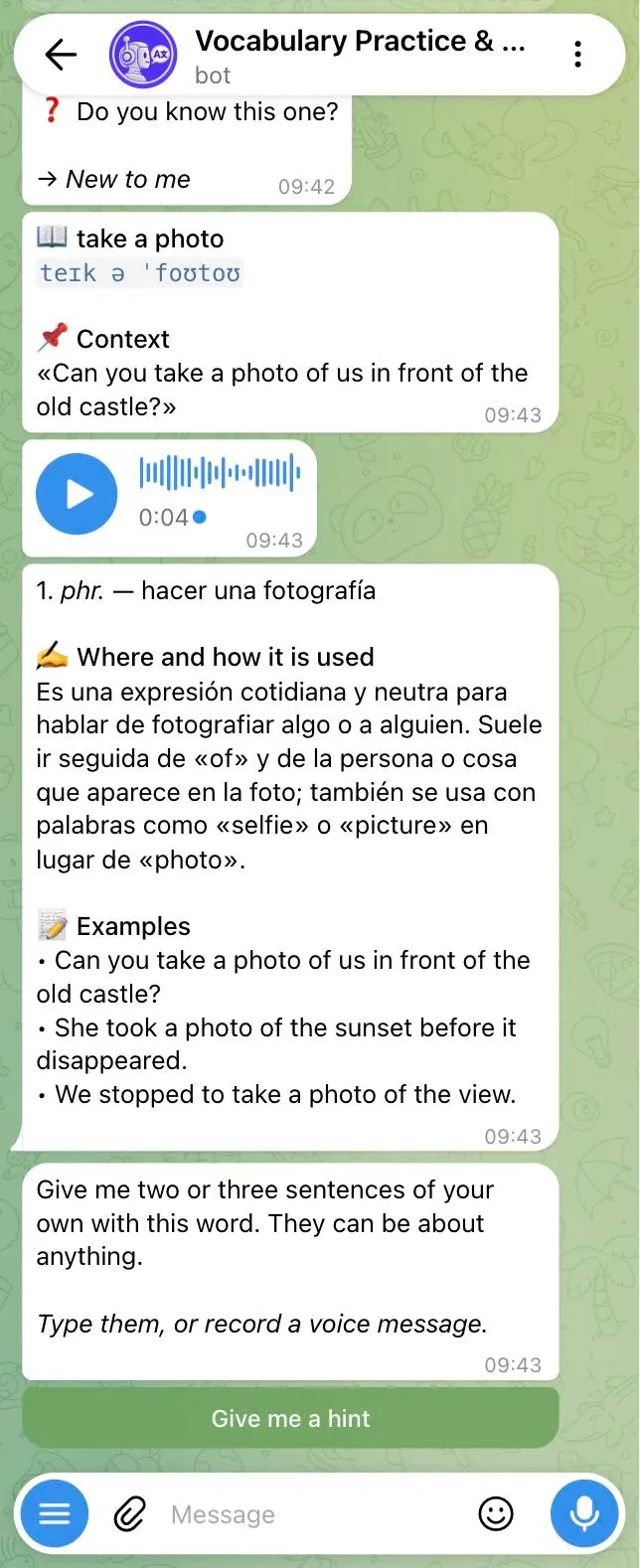
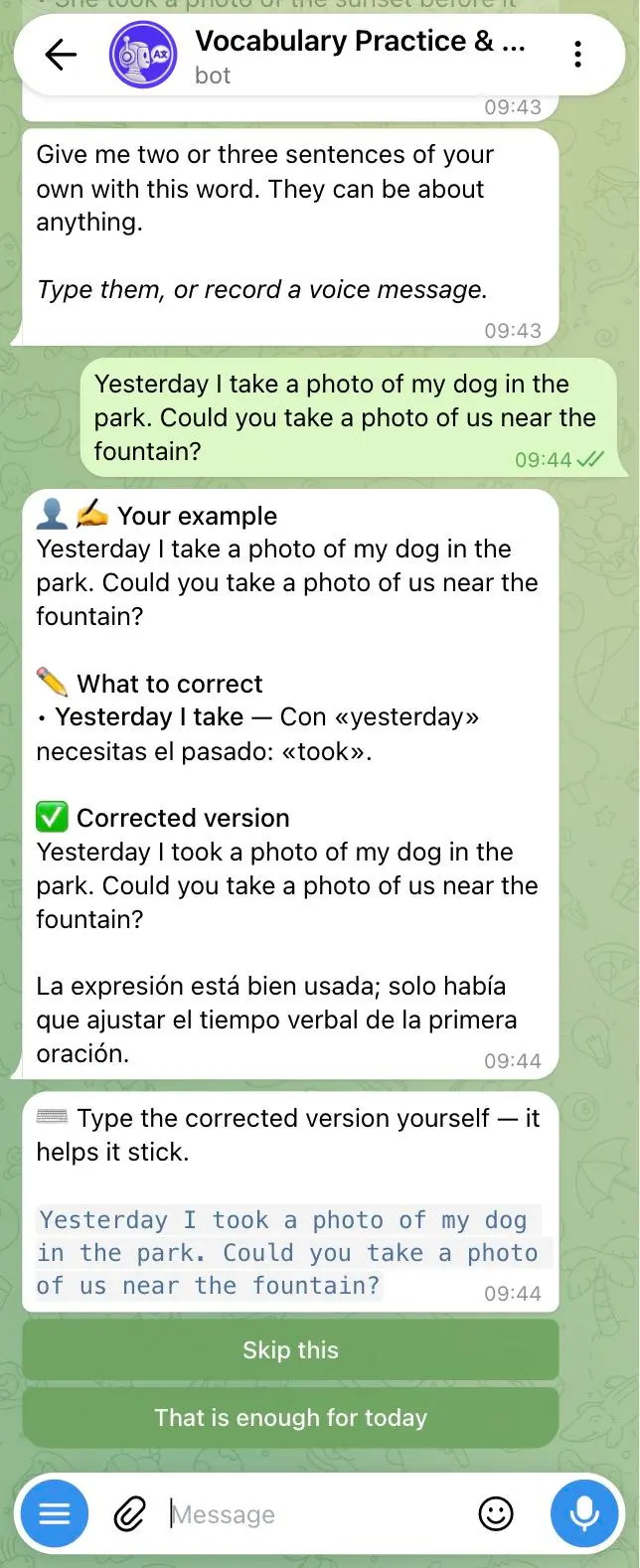
Your own sentences, checked by the AI tutor. You write two or three sentences with the word, by text or voice. The tutor answers in three blocks: your version, what to correct, and the corrected version. It checks word forms, tenses, agreement, word order and how you used the word, and it leaves punctuation alone. Because the format is always the same, you see exactly what changed and why.
Spaced repetition with FSRS. Words come back after a day, then three days, then a week and longer. A word leaves the reviews when its next repeat would be more than six months away. Questions rotate between three types: the meaning from the word, the word from its meaning, and a blank in the line where you met it.
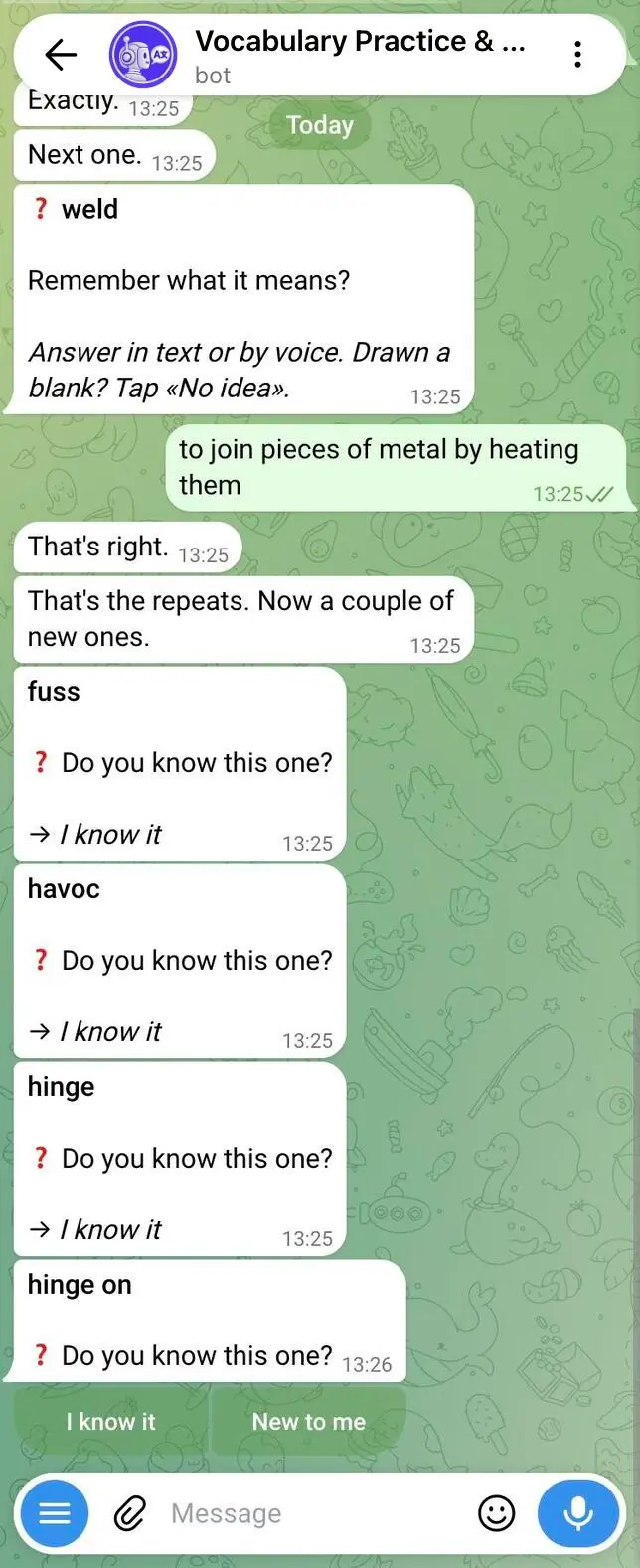
Voice answers. You can answer any question out loud; the bot shows what it heard.
Ask the tutor anything. During a session or between them, there's no limit on questions.
You can learn English, German, Spanish, French, Japanese, Chinese, Russian, Korean, Czech or Polish, with explanations in those languages plus Ukrainian and Bulgarian. The bot itself is free. Importing InterSub words is limited to 5 on the free InterSub plan and unlimited on any paid plan. The team plans more languages, a web app and gamification.
For Anki and other options, see all the ways to practice your words.
ChatGPT vs AI Language Buddy vs InterSub Words bot
| Plain ChatGPT | AI Language Buddy | InterSub Words bot | |
|---|---|---|---|
| What it knows about your words | Only what you paste in | The word you looked up and its scene | Your saved words and the lines you met them in |
| Memory and repetition | Optional memory of you; no review schedule | Saves definitions to your Wordbook | Spaced repetition (FSRS), 3 question types, reminders |
| Voice | Voice conversations | Text chat | Voice answers; audio for the word and its line |
| Corrections | Free-form, can vary | Answers your questions in context | Fixed three-block format |
| Price | Free plan; paid plans for more use | Every InterSub plan, including free; uses your word-lookup allowance | Free bot; 5 imported words on the free InterSub plan, unlimited on any paid plan |
A simple routine
AI language learning works when the AI sits around real input, not instead of it.
- Watch 20 minutes of a show or YouTube channel with dual subtitles. Look up words as you go.
- When a line confuses you, ask AI Language Buddy about it right there, or paste it into ChatGPT with prompt 1 or 7.
- Later, open the InterSub Words bot: write your own sentences with the new words and do the reviews it gives you.
- Once a week, role-play with ChatGPT (prompt 4) using words from that week.
- Rewatch a favourite scene and repeat lines out loud with the shadowing technique.
If you are looking at apps more broadly, our list of Duolingo alternatives groups them by what they add.
Frequently asked questions
Can ChatGPT teach you a language?
It can teach you a lot about a language: grammar, word meanings, examples and corrections, and it is a patient partner for written or spoken practice. It can't give you hours of real listening, and it doesn't plan your reviews, so use it next to real video and a spaced-repetition tool.
Is ChatGPT good for language learning?
Yes, for explanations, example sentences, role-play and correcting short texts. It is weaker on facts such as etymology, it can correct the same sentence differently twice, and it has no built-in schedule for repeating words.
What are the best prompts for learning a language with ChatGPT?
Short prompts with clear limits work best: give it the exact line you heard, say your level, ask it to correct without rewriting, or ask it to quiz you one question at a time. Eight ready-to-copy prompts are in the article.
What is the best AI tutor for language learning?
It depends on the job. A general chatbot is fine for open questions; a tutor connected to what you watch, such as AI Language Buddy in the InterSub extension, explains a word in the scene you saw it, and the InterSub Words bot turns saved words into practice with spaced repetition.
Is the InterSub Words bot free?
Yes, the bot itself is free and has no subscription. Importing words from your InterSub Wordbook is limited to 5 words on the free InterSub plan and unlimited on any paid plan; you can also upload your own words or pick ready-made topics.