
Japanese Honorifics: -san, -kun, -chan and More in Anime
Japanese honorifics as you hear them in anime: -san, -kun, -chan, -sama, senpai, -dono, -tan, -chi, with example lines, a reference table and how to spot them.
Japanese honorifics are the small suffixes added to names, like -san, -kun, -chan and -sama, that show how the speaker relates to the person they are talking to: polite or close, senior or junior, respectful or teasing. In anime you hear them in almost every line, and English subtitles almost always drop them. This guide goes through each one with a short example line, so you can hear what it changes in a scene.
Why English subtitles drop the suffix
Take a simple line where one classmate calls another:
田中くん、一緒に帰ろう。
Tanaka, let's walk home together.
The English is correct, but the -kun is gone. In Japanese it tells you a lot: the speaker uses his family name, not his first name, so they are not that close yet; -kun says he is a boy of the same age or younger, and the tone is friendly. If ten episodes later she calls him by his first name with no suffix at all, that is a turning point in the story. With English subtitles only, you miss it.
That is the main reason to watch with dual subtitles: the Japanese line keeps the suffix, the English line keeps the meaning, and you see both at the same moment. More on setting that up at the end.
Japanese honorifics list, one by one
These Japanese suffixes are attached to a name (Tanaka-san) or to a title (sensei, senpai). You never use them about yourself, except as a joke or a character trait. Here is the Japanese honorifics list you meet most in anime and shows.
-san: the safe default
So, what does san mean in Japanese? It is roughly Mr. or Ms., but neutral: it works for men and women, with family names or first names. Shop staff, neighbors, coworkers, a friend's mother all get -san.
佐藤さん、この資料お願いします。
Sato, could you take care of these papers?
Nothing dramatic happens in the scene, and that's the point: -san keeps a polite distance. When a character switches from -san to -chan or to no suffix, the distance is closing.
-kun: boys, juniors and coworkers
If you wonder what does kun mean in Japanese, think of a classmate or a junior: it's used mostly for boys and young men, by people of the same age or older. Teachers use it for male students, and a boss can use it for a junior employee, sometimes for women too.
健太くん、また遅刻?
Kenta, late again?
Here the speaker is an equal or a senior. A student never calls a teacher anything-kun.
-chan: cute and close
As for what does chan mean in Japanese, it's the affectionate form for small children, girls among friends, partners, pets, and often grandparents (obaa-chan). Close friends of any gender can use it.
ゆいちゃん、それ可愛いね!
Yui, that's so cute!
It adds warmth. Used with someone the speaker barely knows, it sounds pushy, and anime plays this for comedy all the time.
-sama: high respect
And what does sama mean in Japanese? A more respectful -san, used for customers (okyaku-sama), letters, gods, and anyone the speaker puts far above themselves.
お嬢様、お車の用意ができました。
Miss, the car is ready.
The line sets up rank. In anime the speaker is often a butler, a maid, a devoted follower, or a fan talking about an idol. A character who calls himself ore-sama is being arrogant on purpose.
Sensei and senpai: titles you can use alone
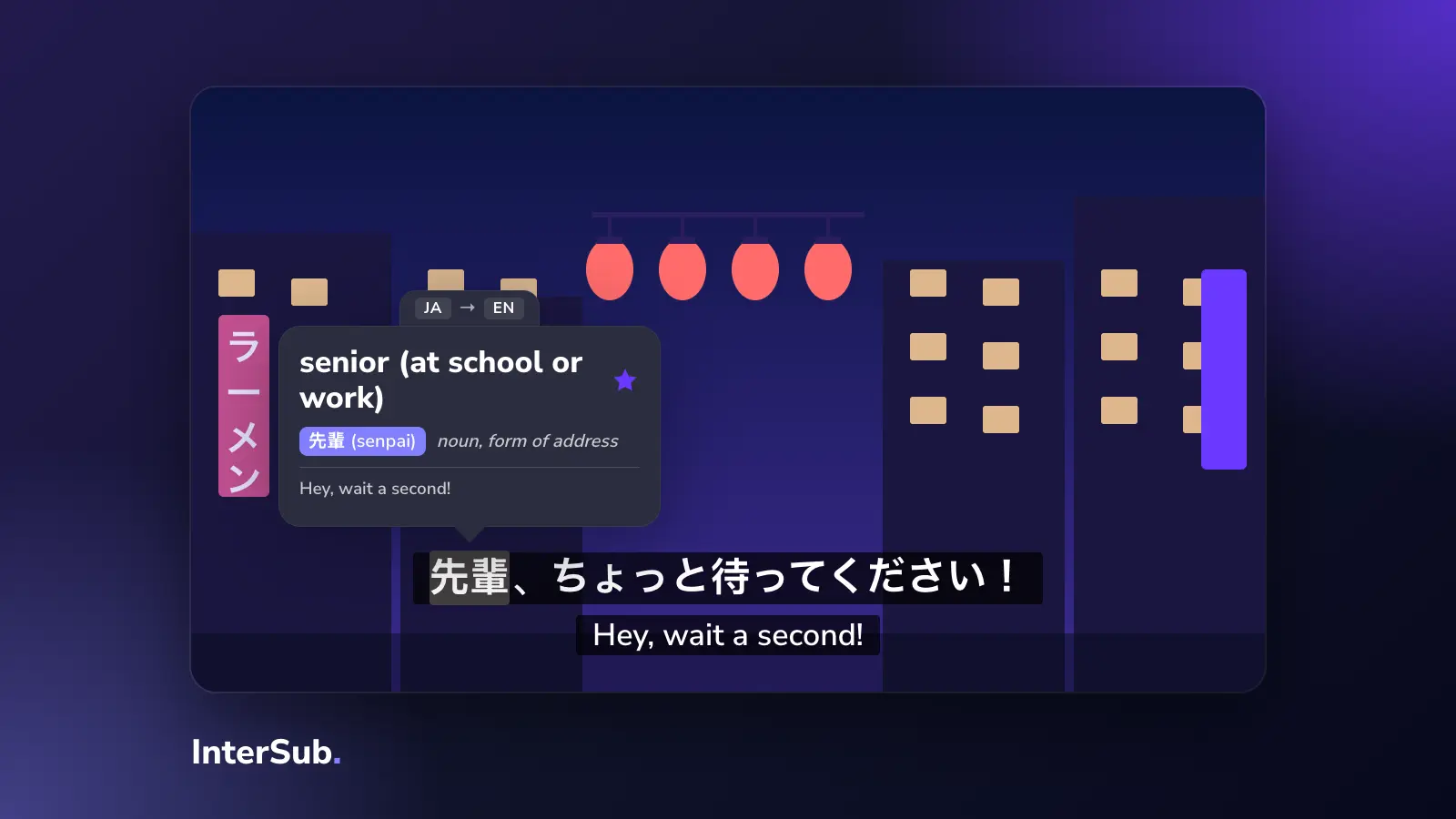
Sensei is for teachers, doctors, lawyers, writers, artists and masters of a skill. Senpai is anyone who started before you at the same school, club or job. Both can follow a name or stand alone.
先輩、ちょっと待ってください!
Hey, wait a second!
The English turned 先輩 into "hey", but in Japanese the speaker is clearly the junior, the kōhai. Note that juniors are never called kōhai to their face.
-dono: old-fashioned and official
-dono once meant something like "lord" and ranks below -sama. Today you rarely hear it in speech. It survives in some certificates, awards and official forms, and in anime from samurai-era characters or anyone who wants to sound stiff and formal.
山田殿、お見事でござる。
Well done, Yamada.
That brings up the classic Japanese honorific dono vs sama question. In modern life, use -sama. Many city offices in Japan now write -sama even on documents where -dono used to be standard, because -dono can read as addressed from above.
-tan and -chi: playful nicknames
The Japanese -tan suffix is a baby-talk version of -chan, as if a small child mispronounced it. It is even cuter, and you see it with babies, very close friends and mascot characters drawn as cute girls, for example Wikipe-tan, the unofficial Wikipedia mascot.
ミクたん、今日も最高!
Miku, you're the best as always!
The Japanese -chi suffix, usually spelled -っち (-cchi), is a playful nickname ending between friends: Satoshi becomes Sacchi, Nao becomes Naocchi. It is casual and slightly silly. Despite the look, Tamagotchi has nothing to do with it: the toy's name comes from tamago (egg) and the English word "watch".
No suffix (yobisute)
Calling someone by bare name is yobisute. Between family members, partners and close friends it is normal. From a stranger, a junior or a rival it sounds rude or aggressive. Shonen rivals often shout each other's family names with no suffix, and that is part of the hostility.
Reference table
| Honorific | Who uses it to whom | Example line | Nuance |
|---|---|---|---|
| -san | Anyone to adults outside close circle | 佐藤さん、おはようございます。 Good morning, Sato. | Polite, neutral distance |
| -kun | Equals or seniors to boys, juniors | 健太くん、また遅刻? Kenta, late again? | Friendly, sets the speaker as equal or senior |
| -chan | To children, girls, close friends, partners | ゆいちゃん、行こう! Let's go, Yui! | Warm, cute; pushy with strangers |
| -sama | To customers, masters, gods, idols | お客様、こちらへどうぞ。 This way, please. | Deep respect or servitude |
| sensei | Students, patients, fans to teachers, doctors, artists | 先生、質問があります。 I have a question. | Respect for expertise |
| senpai | Juniors to seniors at school, club, work | 先輩、待ってください! Wait for me! | Respect plus a little admiration |
| -dono | Officials, old-style characters | 山田殿、お見事です。 Well done, Yamada. | Archaic, stiff, official |
| -tan | Close friends, fans, mascots | ミクたん、最高! Miku, you're the best! | Baby talk, extra cute |
| -chi (-cchi) | Close friends | なおっち、遅いよ! Nao, you're late! | Playful nickname |
| none | Family, partners, close friends, rivals | 健太、こっち来い! Kenta, come here! | Very close or openly rude |
Anime phrases learners copy wrongly
Some anime phrases sound cool in a show and odd in real life.
- Calling yourself with a suffix. Characters who refer to themselves as their own name plus -chan are being cute on purpose. Adults do not do this in normal conversation.
- "Senpai" for anyone older. Senpai only works inside a shared group: same school, club or company. An older stranger is not your senpai.
- -sama for friends. It sounds sarcastic or like role play. Use -san, or a first name with -chan or -kun if you are close.
- Dropping the suffix to sound natural. Yobisute is earned. Calling a new Japanese acquaintance by bare first name can feel rude, even if anime friends do it all the time.
- -dono as a "cool" formal form. It sounds like a period drama. In an email to a business contact, write -sama.
How to notice honorifics while you watch
Honorifics are short and fast in speech, so the easiest way to catch them is to read them. Watch with Japanese subtitles on top and English, or your own language, below. When the English line says only "Kenta", look up at the Japanese line and check: Kenta-kun, Kenta-san, or plain Kenta? After a few episodes you start hearing the difference without looking.
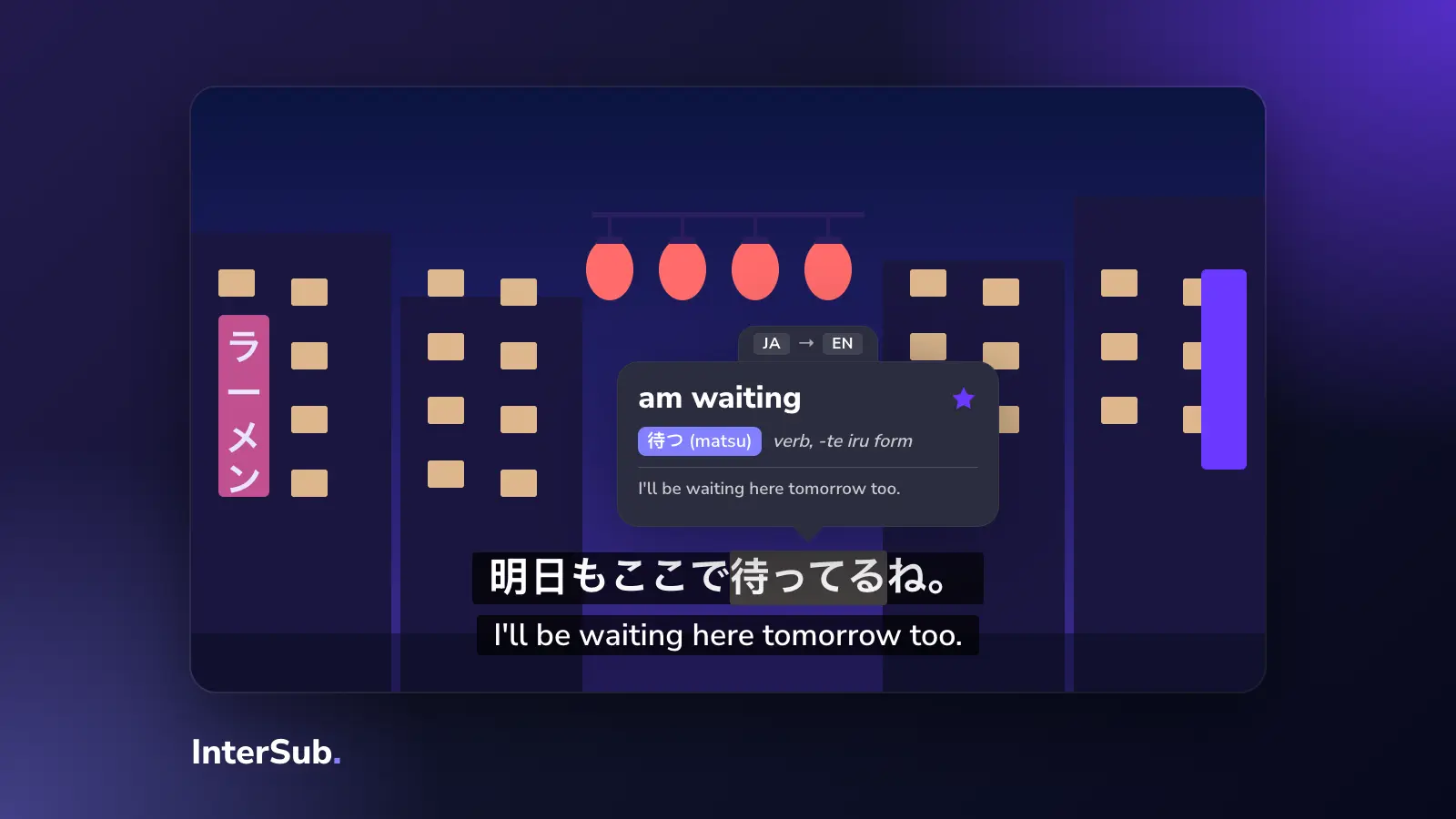
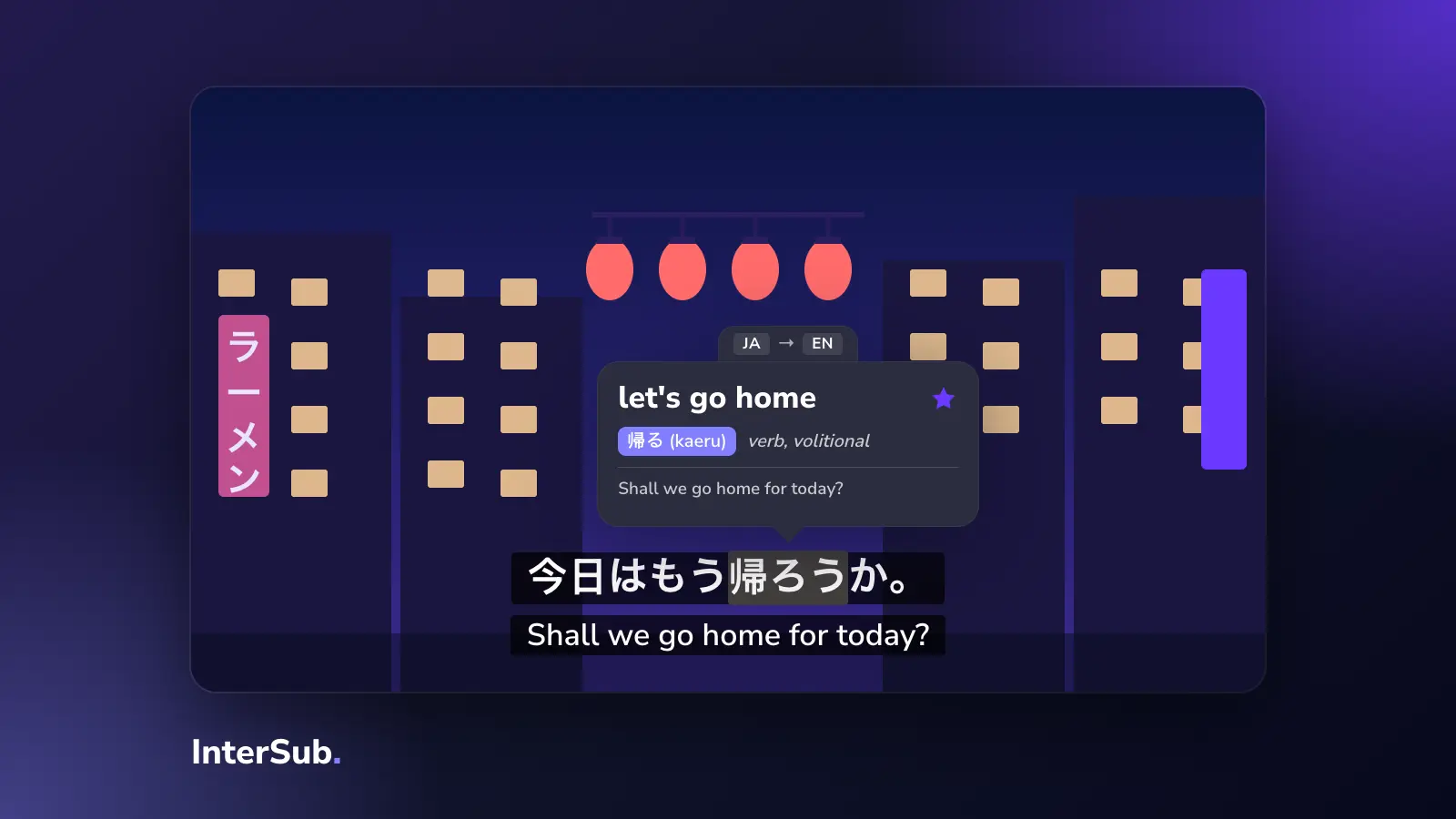
InterSub shows both lines in Chrome, Edge or Firefox on Crunchyroll, Netflix, YouTube and other platforms. Hover over a word, a name with its suffix included, and the video pauses and shows the translation in context. Every word you look up goes to your Wordbook with the line it came from, so you can review it later or send it to Anki. If you want to learn Japanese with anime, that page covers the Crunchyroll setup.
A note on availability: InterSub uses the subtitles the platform provides. Many anime titles, especially regional releases, have no Japanese subtitle track. In that case the paid AI subtitle translation can generate the second line, but a Japanese track has to exist for you to see the original suffixes. For Netflix, see our guide to Netflix Japanese subtitles; for live-action films, try the list of Japanese movies with subtitles.
A simple practice routine
- Pick one episode of a school or workplace anime, where the relations are clear.
- Watch with Japanese and English subtitles. Each time a name comes up, check which suffix it has.
- Hover the names and titles you are unsure about and save them to your Wordbook.
- At the end, ask yourself who is senior to whom and who is close to whom. The suffixes usually answer it.
Soon you'll catch the moment a character changes how they address someone. That's often where the story turns.
Frequently asked questions
What does san mean in Japanese?
-san is the neutral polite suffix, close to Mr. or Ms. but used for any gender and with first or last names. It is the safe default for adults you are not close to.
What does chan mean in Japanese?
-chan is an affectionate suffix for small children, close friends, partners, pets and sometimes grandparents. Using it with someone you just met sounds overly familiar.
What is the difference between kun and chan?
-kun is used mostly for boys and younger men, or by a senior for a junior at school or work. -chan is softer and cuter, typical for girls, children and close friends of either gender.
Is it rude to drop -san in Japanese?
Calling someone by name with no suffix, called yobisute, is normal with family and close friends. With a stranger, a customer or a senior it sounds rude or presumptuous.
What does senpai mean?
Senpai is someone who started before you at the same school, club or workplace. Juniors use it as a title, alone or after the name, and it carries respect and a little dependence.
What is the difference between dono and sama?
Both are respectful, but -sama is the modern standard for customers, letters and anyone you treat as above you. -dono sounds old-fashioned or official today: you see it on some certificates and forms, and from samurai-style characters in anime.